

In the evolving ecosystem of digital advertising, maintaining a healthy Facebook Ads account has become essential for brands, agencies, and performance marketers. Facebook evaluates page risk before restricting advertising to ensure platform safety, protect user experience, and maintain ad quality. Understanding how this evaluation works is critical for advertisers aiming to scale campaigns effectively and avoid sudden account limitations or ad rejections.
1. What Is “Page Risk” in the Context of Facebook Advertising?
Page Risk refers to the likelihood that a Facebook Page could generate ads or content that violate Meta’s policies. Pages with high risk may be restricted from running ads either temporarily or permanently.
Pages are assessed on multiple factors:
- Policy violations
- Engagement quality
- User feedback
- Ad content history
- Compliance with Meta Business & Advertising Standards
2. Core Signals Facebook Uses to Evaluate Page Risk
Facebook does not disclose its complete algorithm, but digital marketing audits and platform documentation confirm several core evaluation signals:
2.1 Policy Violation History
Facebook continuously analyzes:
- Previous ad disapprovals
- Repeated use of restricted content
- Past Account Restrictions
- Pattern of policy infractions
Pages with multiple violations have a higher risk score. For example, a Page with more than 3 violations in 30 days is statistically more likely to be flagged for review.
2.2 Content Quality and User Feedback
Facebook tracks user interactions such as:
- Negative feedback (e.g., hide post, report ad)
- Spam reports
- Low relevance score or engagement
A high number of negative reactions signals poor user experience, increasing risk.
Industry Insight: Ads that receive a negative feedback rate above 0.5% are often penalized in auction performance and may trigger account reviews.
2.3 Landing Page and Conversion Accuracy
Beyond ad text and creative, Facebook evaluates the:
- Landing page experience
- Misleading claims
- Content mismatch between ad and landing page
Facebook’s automated systems compare:
Ad Creative vs. Landing Page Content
Example: An ad promising “Free trial” but landing on a subscription paywall might be deemed misleading.
2.4 Ad Account Trust Signals
Facebook assesses broader business integrity through:
- Business Manager identity verification
- Payment method stability
- Billing disputes or chargebacks
- Past account deactivations
Frequent payment issues or mismatches in business information reduce trust score.
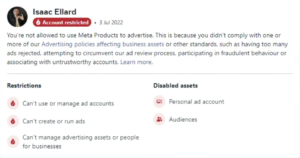
3. Signals That Trigger Automated vs. Manual Review
Automated Review
Triggered by:
- Keywords flagged by AI
- Immediate policy triggers (e.g., political content, health claims)
- High negative feedback rates
Manual Review
Activated when:
- Automated system is uncertain
- Business appeals a decision
- Complex contextual issues arise
Industry Benchmark: Manual review turnaround can range from 24 hours to 72 hours, depending on volume and complexity.
4. How Page Risk Affects Ad Performance and Delivery
Pages flagged with elevated risk scores may experience:
- Lower reach due to reduced auction eligibility
- Higher CPC (Cost Per Click)
- More frequent disapprovals
- Restricted targeting options
Example: A Page with medium risk may see ad relevancy drop by 5–10%, leading to less efficient bidding.
5. Best Practices to Reduce Page Risk and Prevent Restrictions
To maintain a healthy advertising presence:
5.1 Ensure Policy Compliance
- Regularly review Meta Advertising Policies
- Avoid sensitive topics without clear permission
5.2 Optimize Content Quality
- Use clear, accurate creatives
- Avoid clickbait or deceptive promotions
5.3 Improve Engagement Signals
- Encourage positive interactions
- Monitor feedback metrics weekly
5.4 Maintain Transparent Landing Pages
- Match promises made in ads
- Highlight privacy, terms, and contact information
5.5 Use Facebook Tools
- Account Quality dashboard
- Facebook Business Support
- Policy insights and education center
6. Strategic Importance of Understanding Page Risk
Understanding how Facebook evaluates Page Risk is essential for any professional managing high-value Facebook Ads accounts. Comprehensive risk management not only reduces the likelihood of restrictions but also enhances ad performance, audience trust, and long-term media investment returns.
By systematically addressing policy compliance, user experience, content relevance, and account trust factors, marketers can protect ad delivery and maintain competitive advantage on one of the largest digital advertising platforms in the world.