
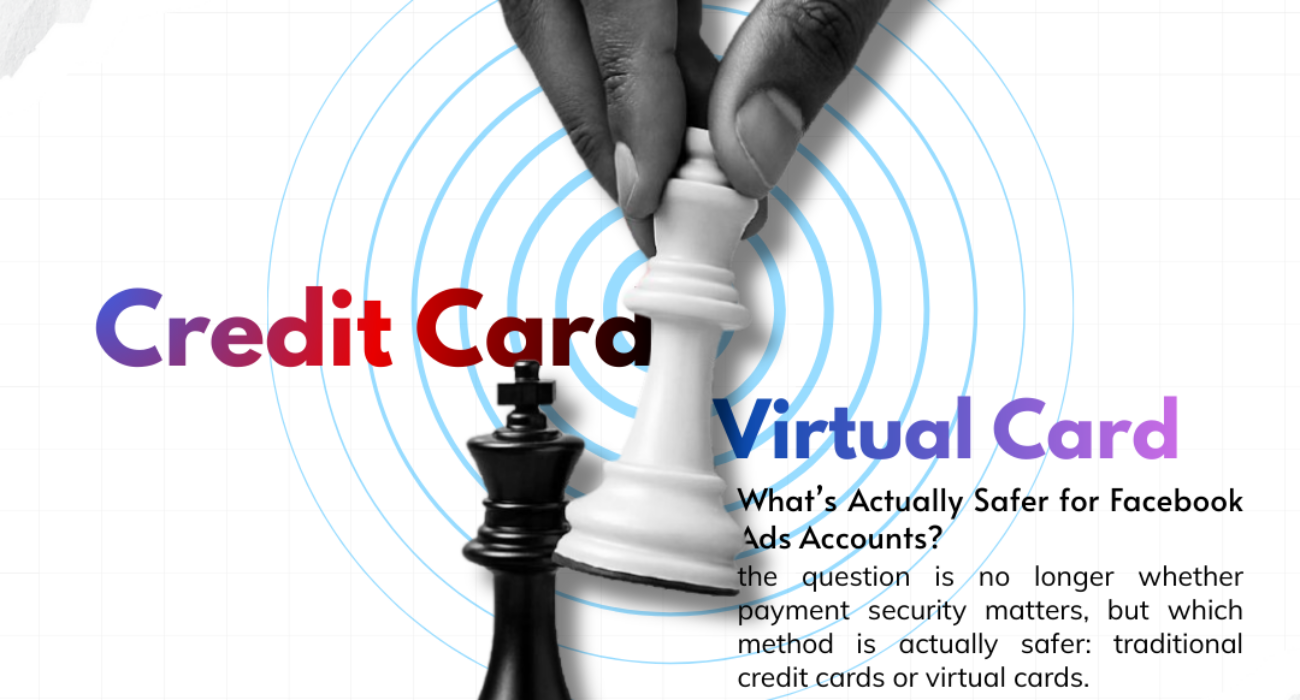
In the Facebook Ads ecosystem, payment security is not a peripheral concern but a core operational risk. A compromised payment method can trigger ad account shutdowns, failed billing cycles, frozen Business Managers, and in high-spend environments, losses that scale into five or six figures within hours. For performance marketers, media buyers, and agencies managing multiple Facebook Ads Accounts, the question is no longer whether payment security matters, but which method is actually safer: traditional credit cards or virtual cards.
Understanding the Risk Surface in Facebook Ads Billing
Facebook Ads Accounts are frequent targets for fraud due to three characteristics: always-on billing, automated spend scaling, and weak real-time human verification once a payment method is authorized. According to global fraud reports, card-not-present (CNP) fraud accounts for over 70% of total card fraud losses, with digital advertising platforms being a prime vector due to recurring billing models. When a primary credit card is compromised, attackers can immediately exploit spending limits across multiple ad accounts before detection.
Traditional Credit Cards: Stability with Systemic Exposure
Traditional credit cards remain the default payment method for most Facebook Ads Accounts because of their high acceptance rate, dispute mechanisms, and predictable billing behavior. Banks provide chargeback protection, fraud monitoring, and sometimes insurance coverage, which offers a safety net after damage occurs. However, this protection is reactive rather than preventive.
From a risk management standpoint, a single physical credit card linked across multiple Facebook Ads Accounts or Business Managers creates a single point of failure. If card data leaks via a compromised browser session, rogue employee access, or malware, all connected ad assets are exposed simultaneously. In real-world agency environments, this has resulted in unauthorized ad spend spikes exceeding $20,000–$50,000 within 24 hours before banks intervene.
Virtual Cards: Granular Control and Proactive Defense
Virtual cards, especially those designed for advertising spend, fundamentally change the security model. Instead of one static card number, virtual cards allow advertisers to generate unique card credentials per Facebook Ads Account, set precise spending limits, define currency constraints, and instantly freeze or rotate cards without impacting other assets.
This compartmentalization dramatically reduces blast radius. If a virtual card is compromised, only the linked Facebook Ads Account is affected, not the entire ad infrastructure. Industry benchmarks from fintech providers indicate that businesses using virtual cards reduce unauthorized transaction losses by up to 40–60% compared to traditional cards, primarily due to instant revocation and spend capping.
Operational Advantages for High-Value Facebook Ads Accounts.

Beyond security, virtual cards provide operational leverage that seasoned Facebook Ads professionals value. They simplify budget forecasting by aligning card limits directly with campaign spend caps, reduce accidental overspend during algorithmic scaling, and improve account health by minimizing failed payments. Failed payments are a known trigger for Facebook Ads Account restrictions, especially on aged or high-trust accounts where stability signals matter.
For agencies managing multiple ad accounts, BM structures, or client portfolios, virtual cards also streamline reconciliation. Each card maps cleanly to one account, eliminating accounting ambiguity and improving compliance, especially in regions with strict financial audits.
So, What’s Actually Safer?
From a purely technical and risk-based perspective, virtual cards are objectively safer for Facebook Ads Accounts than traditional credit cards. Credit cards offer strong post-incident recovery, but virtual cards excel at incident prevention, which is far more valuable in high-spend advertising environments. The optimal setup used by top-tier media buyers is often hybrid: a primary credit card funding a virtual card system, with each Facebook Ads Account isolated by its own virtual card.
Final Takeaway for Facebook Ads Experts
If you are running low-budget tests, a traditional credit card may be sufficient. But if you are operating scaled Facebook Ads Accounts, managing agency-level spend, or protecting high-trust assets, virtual cards are no longer optional, they are infrastructure. In a landscape where a single security lapse can burn months of account warming and trust signals, proactive payment isolation is one of the highest-ROI decisions an advertiser can make.